
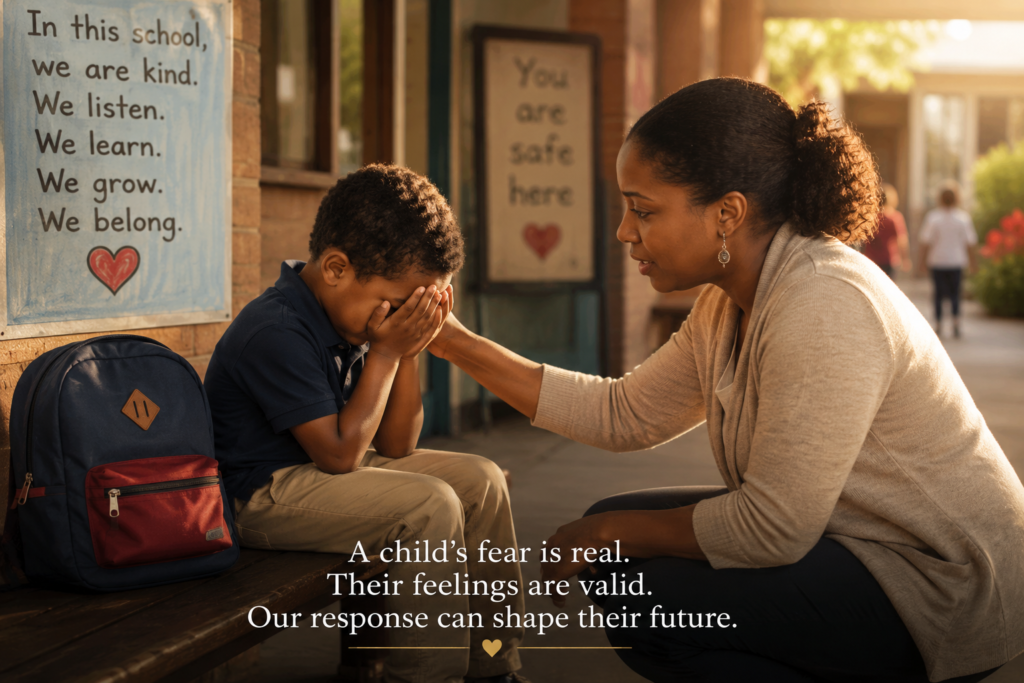
“Hello,” I said gently. “What’s wrong?”
Through tears, he replied, “I’m afraid the teacher is going to hit me.”
I paused.
“Why do you think the teacher will hit you?”
“Because I forgot my homework book at home.”
“Did you finish your homework?”
“Yes.”
“Then come,” I said. “I’ll walk with you to your class and explain to your teacher that you simply forgot your homework book.”
He shook his head.
“No,” he cried. “She is going to hit me.”
I tried again.
“Would you like me to take you home?”
“Yes.”
“Do you know where your home is?”
“Yes.”
“Who brought you to school?”
“My dad.”
“Then let’s wait here. Your dad might come back.”
“It is my sister who picks me up.” ….
Recently, I met this little boy, who could not have been more than four years old.
His father had dropped him off at school, but shortly afterwards, he realized he had left his homework book at home. Unable to return for it himself, he sat quietly on the school veranda and cried.
Before I approached him, I watched several adults notice him, while encouraging him to stop crying and head to class. Others tried to comfort him or reassure him that everything would be alright, yet nothing they said seemed to ease his distress.
It wasn’t until I sat beside him and listened, that I realized what was really troubling him.
No matter what I said, he would not move. His fear was stronger than my reassurance.
Realising I could not persuade him on my own, I walked over to a few teachers and shared what was going on.
They listened attentively and called for his class teacher, who came and gently took him to class.
As I watched them walk away, one thought stayed with me.
The homework book had never been the real problem. Fear was!
Think about what has to happen inside a child’s mind for that belief to take root by the age of four.
By that age, children should be worrying about crayons, storybooks and playground games. Not calculating the consequences of forgetting a homework book!
Somewhere along the way, this little boy had come to associate mistakes with punishment. Whether that belief grew from his own experiences or from what he had witnessed happen to other children, it had become real enough to shape how he viewed school and the adults around him.
That is not discipline.
That is fear.
I still hear his words echoing in my mind:
The Questions We Should Be Asking
As a children’s rights advocate, I could not help but wonder:
- How many children walked into classrooms this morning carrying this same fear?
- How many spent the first lesson worrying about punishment instead of listening to what was being taught?
- How many have become experts at hiding mistakes because telling the truth feels unsafe?
- How many children believe that making a mistake automatically means they deserve punishment?
These are uncomfortable questions.
But they deserve honest answers.
Developmental research consistently shows that children learn best when they feel emotionally safe. When fear becomes the dominant emotion, a child’s attention shifts from learning to self-protection. Curiosity gives way to anxiety, and the mind becomes occupied with avoiding punishment rather than exploring new ideas.
A child who is afraid cannot learn well.
Fear narrows the mind.
It shuts down the very curiosity that education is meant to awaken.
We ask children to be brave enough to raise their hands, guess an answer, get it wrong and try again. Yet bravery cannot flourish where beating is the expected consequence of simply being human.
A Forgotten Homework Book Is Not a Crime
A forgotten homework book is a mistake.
It is not defiance.
It is not laziness.
It is not a crime.
Children forget things.
Adults do too.
We forget meetings.
We misplace our phones.
We leave important documents behind.
Yet when adults make mistakes, no one suggests hitting them so they will remember better next time.
Why then do we find it acceptable when the person forgetting is a child; small, vulnerable and unable to defend themselves?
How can we better support children to learn both at school and at home?
If a four-year-old believes that forgetting a homework book could result in being beaten, then the issue is far bigger than one forgotten book.
It reflects the environment we have created around him.
It tells us that somewhere, a child has begun to believe that his worth, acceptance and even his safety depend on getting everything right every single time.
That is a heavy burden for anyone to carry.
It is an unbearable burden for a four-year-old to sit alone on a school veranda, while the adults around him try to solve a problem that was never really about the homework book.
The Violence We Have Normalised
Several months earlier, I asked a volunteer from Germany a simple question:
“What are some things you have found unusual during your stay in Uganda?”
She paused before replying.
“I have noticed many adults saying, ‘I will beat you,’ while raising their hands whenever a child does something wrong,” she said.
“What surprises me even more is watching an adult physically punish a child for hitting another child during play. I keep wondering how a child is expected to learn not to use violence when the lesson itself is being taught through violence.”
Her words have stayed with me.
Sometimes it takes someone from outside our culture to hold up a mirror and help us recognise behaviours we have normalised without questioning their impact.
Building Something Better
This conversation belongs to all of us.
- Teachers.
- Parents.
- Caregivers.
- Faith leaders.
- Policymakers.
- Community leaders.
- Every adult who has ever raised a hand in frustration and called it discipline.
Positive, non-violent discipline is not a foreign idea, nor is it a permissive one.
It is a skill.
One that can be taught.
One that can be practised.
And one that helps children develop self-discipline, emotional regulation and confidence far more effectively than fear ever will.
Schools should be places of discovery, growth, curiosity and safety;
Children should feel safe enough
- to ask questions.
- to make mistakes.
- to explain themselves.
- to learn.
- And safe enough simply to be children.
Every day, children walk through school gates carrying invisible burdens.
Some carry curiosity and excitement.
Others carry fear, shame and anxiety.
Unless we pause long enough to listen, we may never know what weighs them down.
Because in the end, the story was never about a forgotten homework book!
It was about a child who deserved to know that making a mistake did not make him unworthy.
Perhaps, it is also about the kind of schools and the kind of society we choose to build for every child.